 Drawn light
How to draw a cow in 2 ways will be described in this article! The domestication of cattle changed the face of humanity, and with it, the entire nature of the planet. Humans began domesticating cows about 11,500 years ago in the Fertile Crescent. From there, a farming system based on the breeding of cows (cattle) spread almost everywhere. With the chance to read the genomes of ancient cows and their progenitors, the wild aurochs, comes the opportunity to understand exactly how, when, and where the domestication of cattle took place.
An international group of paleogeneticists has collected this kind of data, extensive both in age and geography, and on this data, they have reconstructed the demographic picture of this process. According to the authors’ conclusion, cows did indeed originally appear in the Fertile Crescent, with only a few tame wild cows giving rise to it. A few domestication events occurred independently in the Levant and later in the Indus Valley.
As dispersal from the Levant to the north and east and from the Indus Valley to the west and south, domesticated herds received gene transfer from local wild bulls. Modern domestic cow still carry their genetic heritage. Scientists conclude that the domestication of cattle did not happen gradually, but in a short time and as a result of a single event of domestication of wild aurochs.
Drawing a cow is not easy, but if you try, you can do it! The journal Nature published an interesting article on the origin of cow (cattle) from wild aurochs. The domestication of cattle has long been debated in science, as the relevance of this topic is unconditional and obvious: the domestication of cattle has fundamentally changed human civilization. There appeared a new type of economy, a new ecological niche for man, which changed his physiology and his demography. Man has benefited in every way from the use of his new cohabitant, but cows, having become dependent on man, have also succeeded. Now numbering about 1.3 billion, cattle are the second most massive mammalian species after humans. Without human involvement, they would not have achieved such success.
Contribution of different groups to the total mammalian biomass. As can be seen, humans and cattle contribute the most. Diagram from the article by L. Greenspoon et al, 2023. From these figures alone, it is clear that the domestication of cattle has changed not only the species involved – humans and cows – but the entire face of the planet. To feed such a large number of large herbivores, colossal areas of pastures are needed; their range is controlled to a large extent by humans rather than by climatic circumstances, and predators and competitors no longer influence their numbers; rather, the opposite. All this has changed the face of nature.
Let’s immediately start drawing the cow!
How to draw a cow for kids (option 1)

Step 1
Let’s start drawing a cute cow by sketching the outlines of its eyes—just draw incomplete circles to make it easier to draw later!

Step 2
Here, we darken the inner part of the cow’s eye as shown in the picture!

Step 3
In this step, we draw an oval at an angle and flattened horizontally!

Step 4
Next, draw a mouth in the shape of an arc with curved lines along the edges!

Step 5
At this stage, we draw the nostrils as two spirals!

Step 6
Let’s continue drawing the outline of our cute cow’s head as a vertically elongated oval!

Step 7
Here, we’re just drawing the outline of our cutie’s ears!
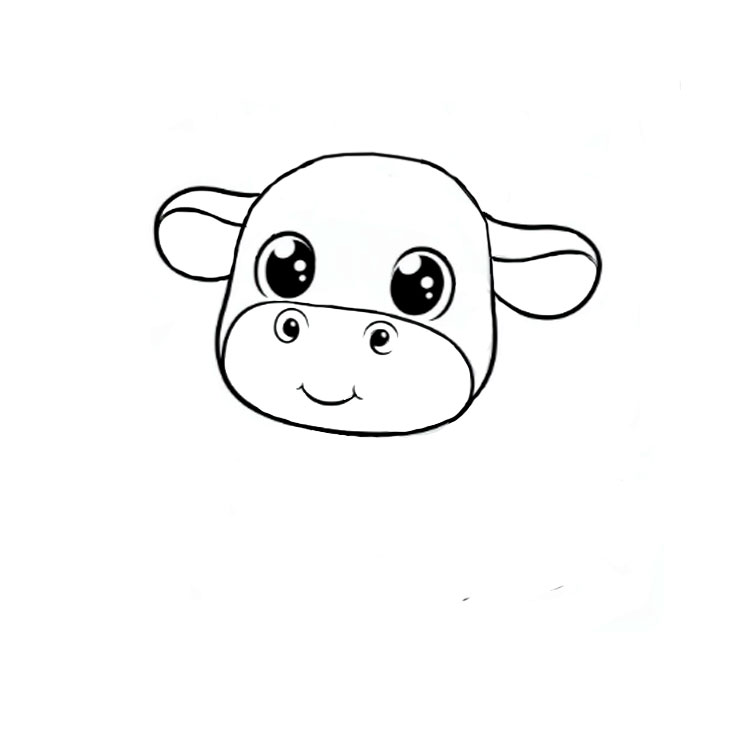
Step 8
In this step, we draw the outline of the horns and a tuft of hair on the forehead!
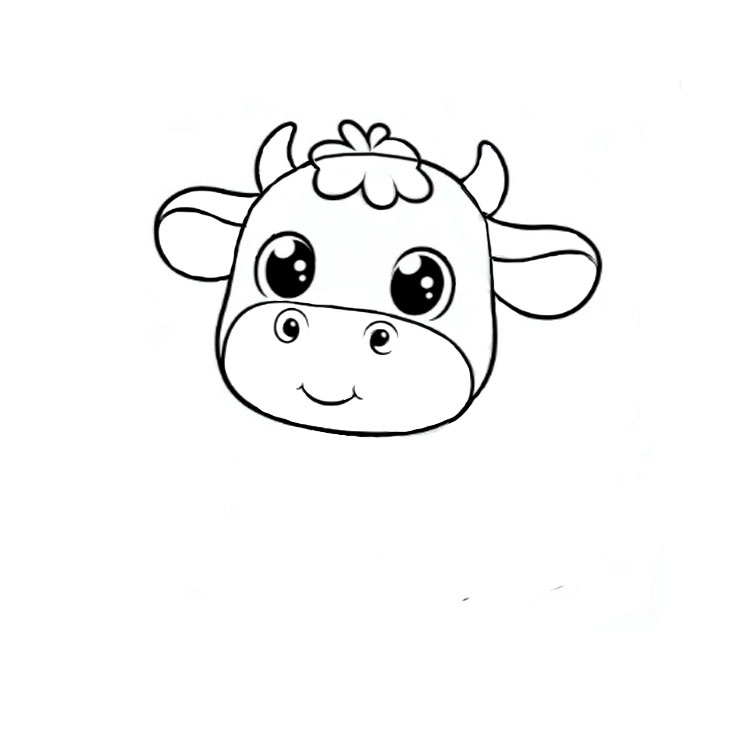
Step 9
Let’s decorate our cow’s face with small details in the form of horizontally curved lines!

Step 10
And now we’re going to draw the outline of our favorite cow’s two front legs!

Step 11
Next, draw the outline of the hind legs and part of the tail!

Step 12
And in this step, we’ll draw the outline of the hooves and the tip of the tail!

Step 13
Let’s add some dark-toned mottled coloring to our heroine’s body!

Step 14
And now let’s finish coloring the face and ears of this cute cow in shades of pink!
How to draw a cow for kids ( option 2)

Children since childhood know that a cow gives milk, “makes mu-mu”, and also cheerfully nibbles grass in the meadow. Some of them saw a cow in a village with a grandmother, some only on the pages of books and cartoons. But, in any case, it will be interesting to learn how to draw a cow for children.
Step 1
Let’s start with the torso. To do this, draw a sizeable horizontal oval.

Step 2
On the right, draw a smaller vertical oval – this will be the head.

Step 3
Let us separate the front part of the face with a semicircular line and draw ears similar to two petals.

Step 4
We now draw straight horns, small eyes and nostrils.

Step 5
Then you need to draw four straight legs. Do not make them too thin – after all, they need to keep quite a lot of weight.

Step 6
And, of course, need a tail with a tassel.

Step 7
The cows are often spotted. Therefore we will add some large oval spots.

Step 8
To make the drawing look more expressive, it is better to bring out the contours.

Step 9
Now we paint. Paint the spots, hooves and tail of the cow with black, the inside of the ears and the front of the face are pink. And do not forget to draw the nipple – it should also be pink.
All drawing is finished.