 Drawn light
How to Draw the earth we’ll explain this in detail in this article. Planet Earth formed as part of the Solar System about 9.2 billion years after the Universe began. During a chaotic period (4,568–4,500 million years ago), the Earth accreted, differentiated into a core and a mantle, and the Moon formed. The planet’s geological history began during the Hadean eon (4.5–4.0 billion years ago). During this time, its formation was shaped by constant asteroid bombardments.
From the Early Archean (4.0–3.1 billion years ago), cosmic impacts ceased to be the dominant factor; crustal tectonics and mantle upheavals took the lead, driving differentiation of Earth’s interior under higher heat. During this stage, the solid iron core began to form.
During the transitional period (3.1–2.0 billion years ago), the tectonic regime was characterized by the movement of small lithospheric plates; the rate of crust formation increased sharply; the asthenosphere emerged within the upper mantle; and the D″ layer formed in the lower mantle. The late period of geological history (<2 billion years ago) was governed by processes of global tectonics, which included lithospheric plate tectonics and mantle plume tectonics. These processes determined the supercontinental cyclical nature of Earth’s development and the sharp increase in metallogenic diversity during that time.
There are many different ways to draw the Earth—there are plenty of options and techniques—but here we’ll show you how to do it using guide lines. Overall, the Earth’s geological evolution was characterized by an increasing complexity of structure and the emergence and consolidation of various geospheres, including the biosphere and the noosphere. Its primary outcome was the creation of conditions on Earth conducive to the emergence and successful development of humankind and human civilization.
The time of Earth’s formation is of great significance. When the universe was formed 13.7 billion years ago as a result of the Big Bang, the fusion of elementary particles led to the formation of the first chemical elements—hydrogen and helium—which served as the primary material for the birth of stars. Thermonuclear reactions took place in their cores, resulting in the formation of other chemical elements. When supernovae exploded, these elements were dispersed into interstellar space, but overall, the early Universe did not contain them in the quantities necessary for the formation of Earth-like planets.
The Solar System formed 9 billion years after the birth of the Universe, when various chemical elements had accumulated in sufficient quantities. It formed 27,000 light-years from the center of the Milky Way galaxy, in a region (between 23,000 and 30,000 light-years) considered most favorable for the emergence of life on the planets of the Solar System. The formation of the Solar System was triggered by a supernova explosion, which interacted with a gas-and-dust cloud and seeded it with short-lived isotopes, allowing scientists to decipher the early stages of development of both the entire Solar System and, above all, Earth.
Let’s get started on drawing the Earth right away!
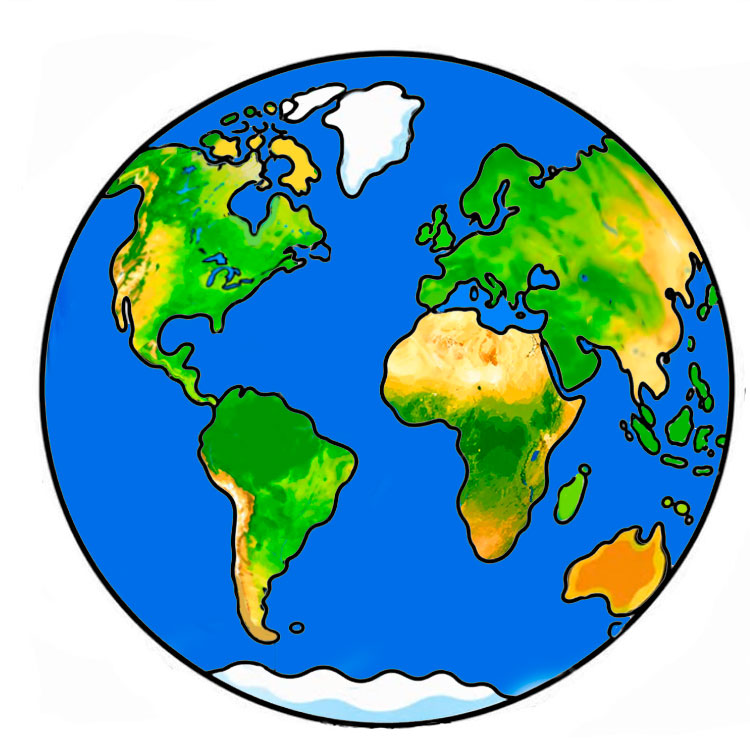
How to Draw the Earth easy
Step 1
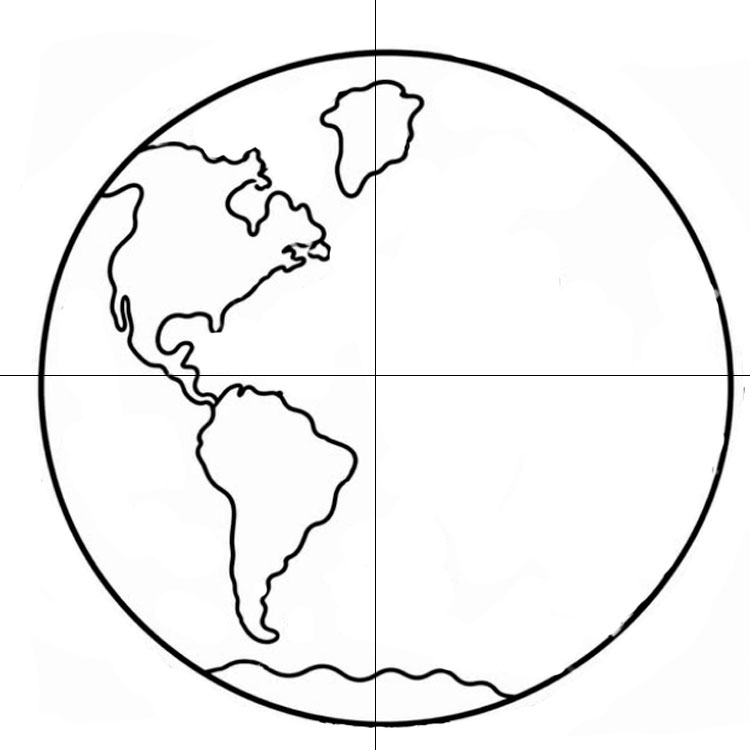
The first step in drawing the Earth is to create guide lines: one horizontal and one vertical, intersecting at the center.

Step 2
Next, we draw a circle with its center at the intersection of these lines, and we also sketch the outlines of Greenland and Antarctica.

Step 3
At this stage of the drawing, we are creating the outlines of North and South America, connected by the Isthmus of Panama.
Step 4
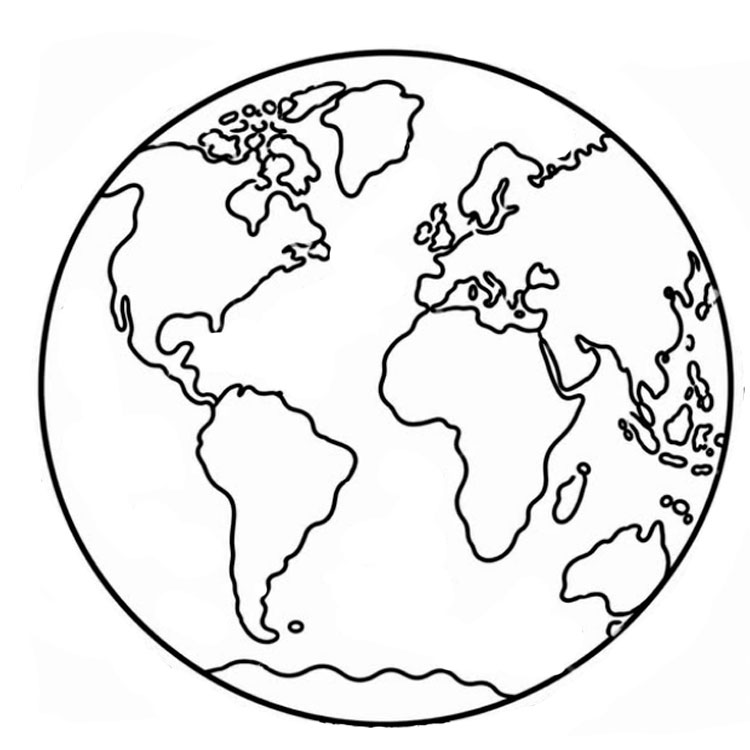
And here we’re drawing the outlines of Africa and Australia.

Step 5
We are creating outlines of Eurasia and the islands adjacent to it.

Step 6
We remove the guide lines that made it easier to draw by dividing the drawing into separate segments.
Step 7
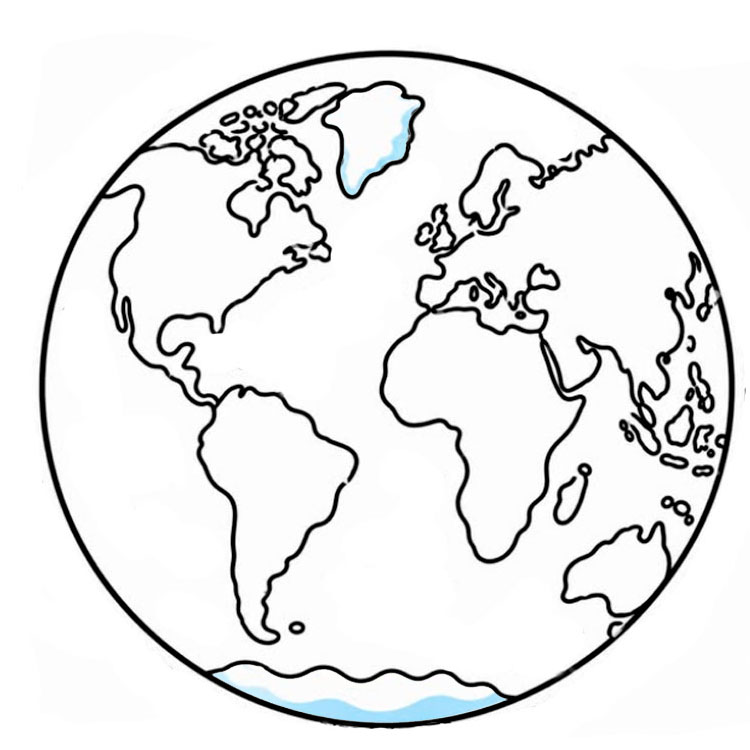
Let’s start coloring our map of the world, starting with Greenland and Antarctica, giving them a light blue tint.
Step 8
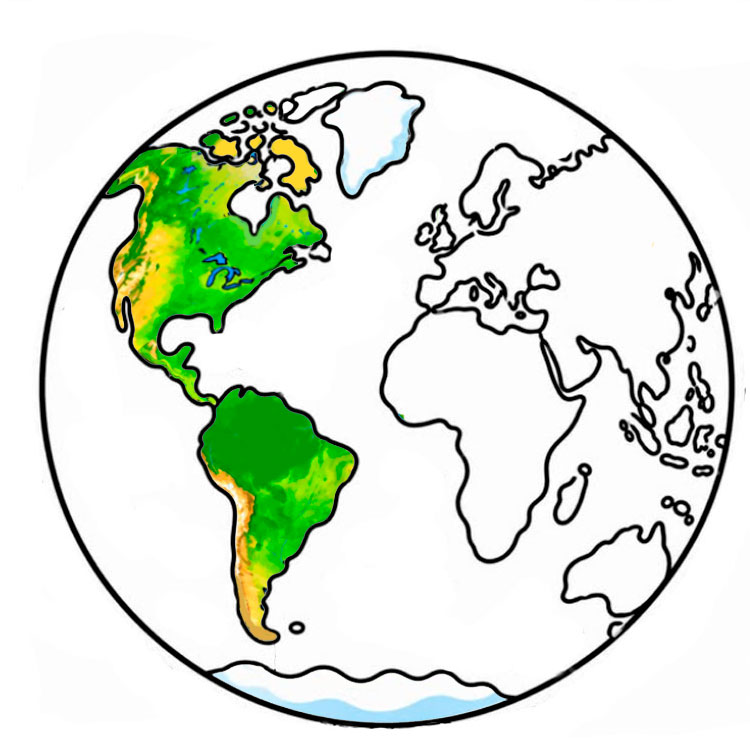
Next, we color North and South America, including the Isthmus of Panama, in bright green and light brown shades.
Step 9
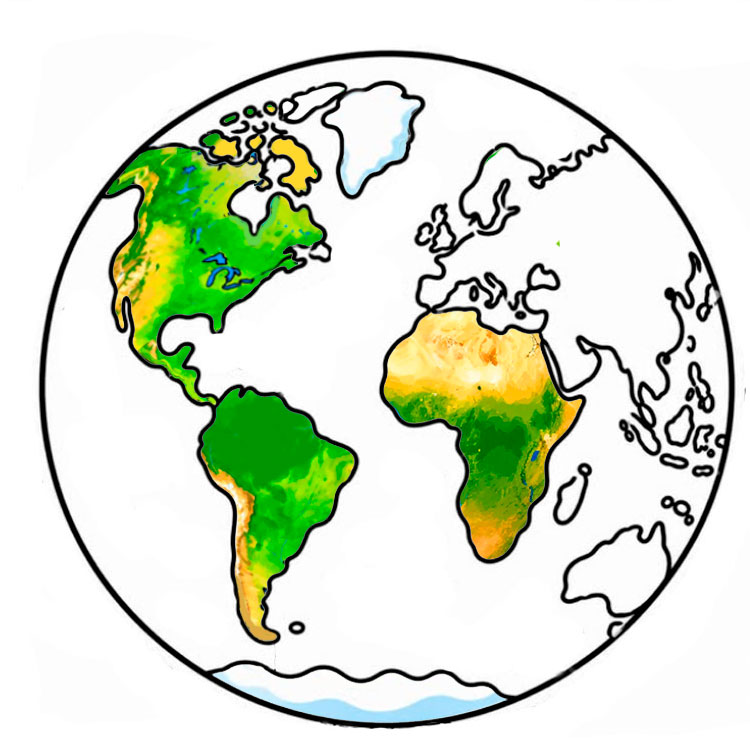
In the same way, we coloring the africa with bright, colorful shades.
Step 10
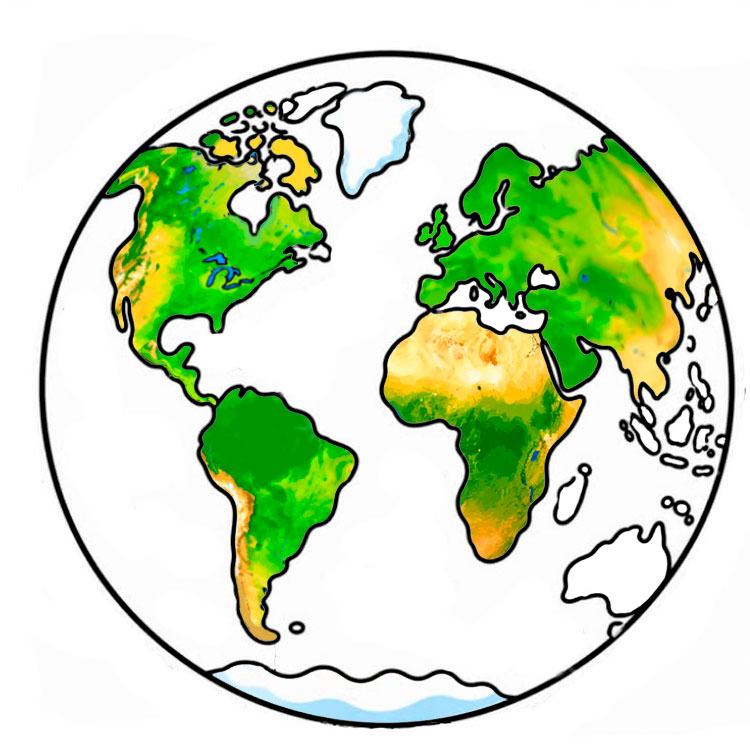
And we’ll give the Eurasian continent a dark green hue with light brown tones.
Step 11
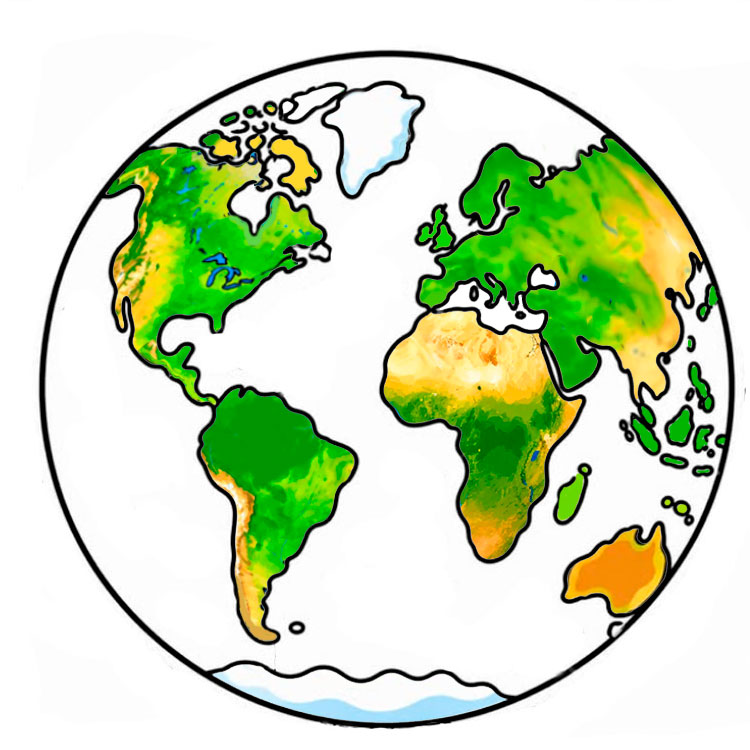
In this step of the drawing, we’ll color Australia and the small islands in bright colors.
Step 12
And we finish coloring the earth by giving its boundless waters a bright blue color.